

KITCHEN BASICS · LESSON 01
Your First Kitchen
You don’t need a kitchen full of gadgets to make something good. You need a place to begin, a few things that work, and something you’d actually like to eat.
Setting up a kitchen can be exciting—right up until you discover there are seventeen different gadgets for peeling a potato. Who knew a potato could be so demanding?
Before you buy anything, have a look around. A kitchen grows with you. You don’t have to furnish the whole thing before you’ve made your first meal.
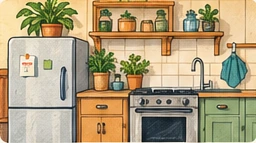
1. Look before you make a shopping list
Open the cupboards. Check the stove, refrigerator, freezer, counter space, and available outlets. Is there an oven? A microwave? Enough room to chop an onion without balancing the cutting board on the toaster?
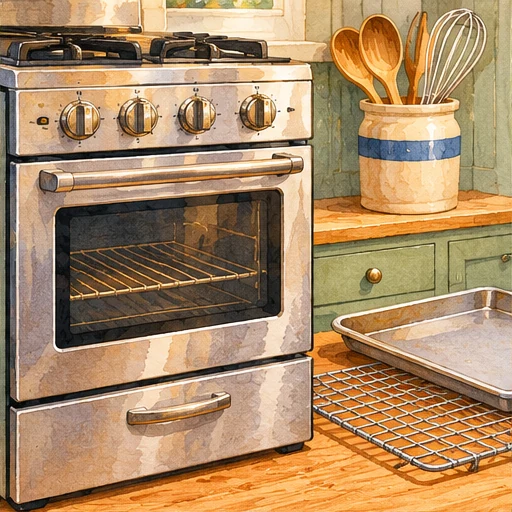
Write down what the kitchen already has, what you own, and what you might borrow. Find the appliance model numbers and read the manuals before using unfamiliar equipment. If you’re in a dorm or shared rental, check which appliances are allowed before bringing one home.
Now think of three meals you enjoy. Not three meals you imagine a proper grown-up is supposed to cook. Your meals. Soup, eggs and toast, a sandwich, rice and vegetables, or something your family always made are all fine places to begin.
Look at what those meals require. That’s the start of your equipment list.
Look for the jobs your kitchen can already do
A burner and a saucepan can handle oatmeal, rice, soup, vegetables, and sauces. A microwave can warm leftovers, cook oatmeal, steam some vegetables in a suitable covered dish, and do more when the recipe gives microwave instructions. The important question is not whether the kitchen looks complete. It is whether you can safely make the foods you actually want to eat.
Take stock of outlets, counter space, ventilation, and where the cutting board can sit without sliding. Open the cabinets before ordering organizers: you may find shelves that simply need to be rearranged. Do not overload outlets or use extension cords for high-power countertop appliances; follow the appliance’s instructions.
2. Cover five everyday jobs
A kitchen has work to do. Start with the work, not a catalog full of matching things. The stores will be delighted to sell you an entire set. They aren’t the ones who have to find cupboard space for it.
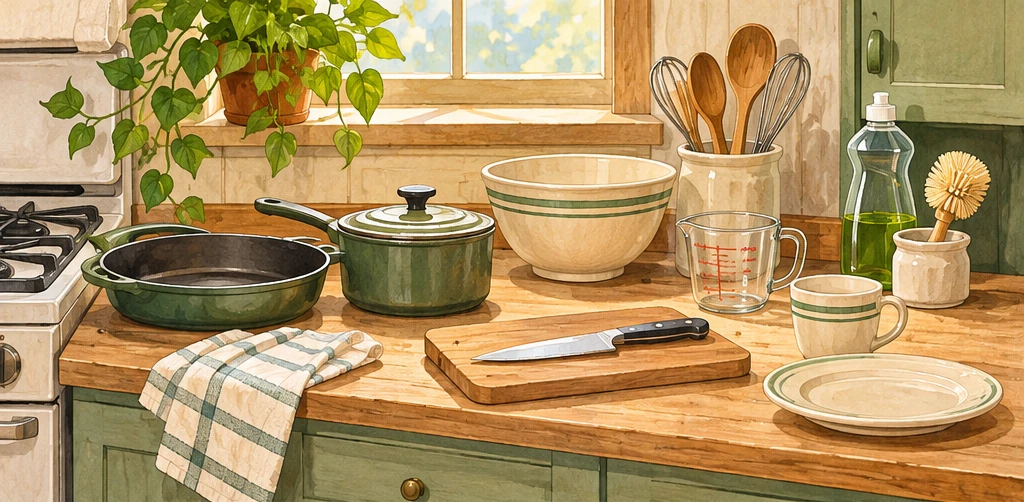
| Job | A practical starting collection |
|---|---|
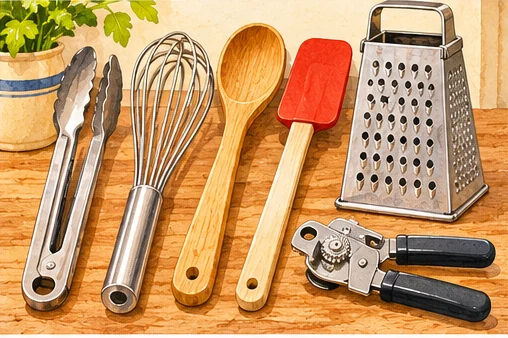
| Prepare | A stable cutting board, a comfortable knife, a bowl, measuring tools, and a manual can opener if you use cans. |
| Cook | A suitable pan or microwave-safe dish, a cooking utensil, and dry oven mitts. Choose for the meals and appliances you have. |
| Eat | A plate or bowl, a mug or glass, and eating utensils for the people using the kitchen. |
| Store | A few food-safe containers with lids and something to label them with. Make sure they fit your refrigerator. |
| Wash up | Dish soap, a washable cloth or brush, a way to dry dishes, and a place for trash. |
Nothing needs to match. A perfectly good saucepan doesn’t care what color your plates are. What matters is that the equipment is intact, appropriate for its job, and comfortable for you to use.
For additional guidance, see N.C. Cooperative Extension and the Academy of Nutrition and Dietetics. Their kitchen-equipment advice can help you think through choices, not dictate a shopping list.
A few shapes tell you what a tool does
A deep saucepan holds liquid without spilling easily; a wide skillet lets moisture escape so food can brown. A rimmed sheet pan catches juices and keeps roasted vegetables from rolling off the edge. Tongs give you a firm grip for turning food; a flat turner slides under it. Once you know the job, the tool aisle becomes a lot less mysterious.
If you inherit or find a useful pan, inspect the handle, bottom, cooking surface and care instructions. A piece does not need to match its neighbors to belong in your kitchen.
3. Give things a practical home
Put the things you reach for often where they’re easy to reach. Keep a clear patch of counter for preparing food. Store heavy pots where you can lift them comfortably, and leave a heat-safe place to set down hot cookware.
Keep towels, packaging, and other flammable items away from burners. Keep oven mitts handy but away from the heat. Turn pot handles inward, away from the counter edge and other burners. Follow your appliance manual’s ventilation and clearance instructions.
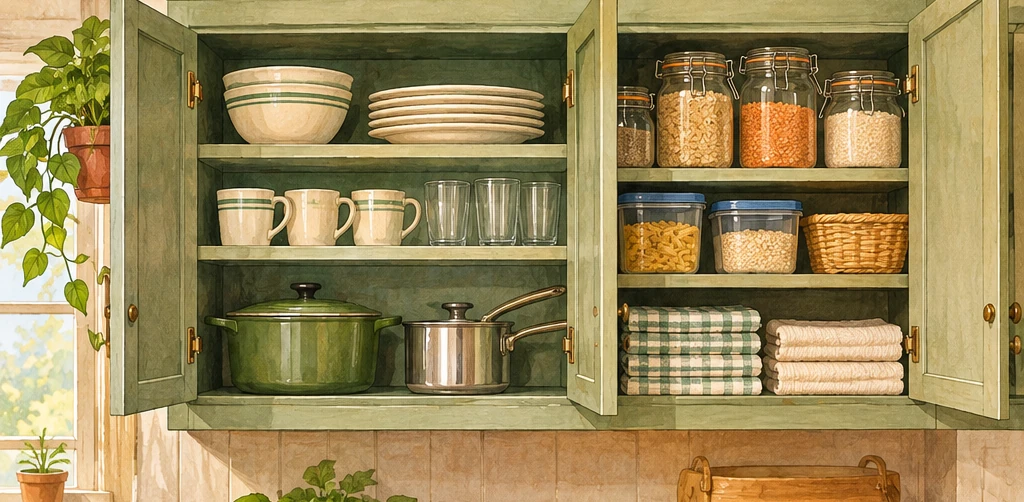
You don’t need a row of decorative jars with matching labels. A clean, dry shelf and properly closed packages work just fine. If the labels help you, wonderful. If they don’t, the rice will survive.
For stove safety, see the U.S. Fire Administration’s cooking fire-safety guidance.
Three locations worth knowing from day one
Know where the fire extinguisher is, how to turn off the stove, and where the food thermometer lives. Keep a properly fitted lid close when cooking in a pan. These are better discoveries to make on a quiet afternoon than when something starts smoking.
Store cleaning products away from food, and keep them in their original labeled containers. Never combine cleaners, even if each bottle claims to be a miracle on its own.
4. Buy for the first few meals
Now comes the enjoyable part: deciding what to make. Choose three meals you genuinely want to eat, read the recipes, and see which ingredients overlap.
One loaf of bread might become toast and sandwiches. A bag of frozen vegetables can find its way into soup, rice, or pasta. Ingredients don’t have to live their whole lives in a single recipe.
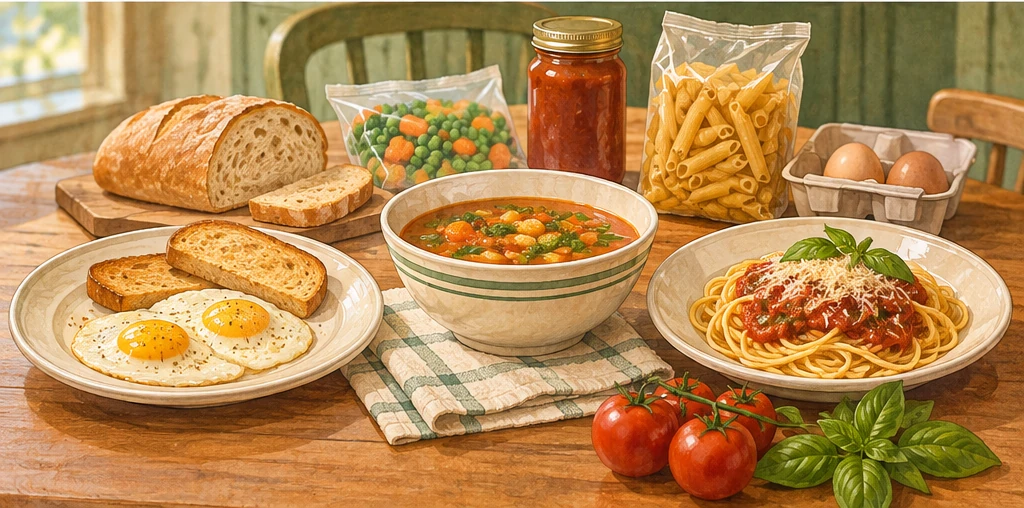
Buy amounts you can use and store. That enormous spice collection can wait until you know which spices you actually enjoy. See Stocking & Shopping for more help getting started.
Not sure which meals to choose? Browse the Feed Me Food Fuel Board. Pick a few free recipes that sound good, check the ingredients, and make your list from there. No account is needed to browse.
Put refrigerated foods away promptly. Check with an appliance thermometer that your refrigerator is at 40°F (4°C) or below and your freezer at 0°F (−18°C) or below. Follow the FDA’s food-storage guidance.
Try the three-meal test
Suppose you like oatmeal, bean-and-vegetable bowls, and pasta. The same pot may cook the oats and pasta. A skillet can warm the beans and vegetables; the cutting board, knife and spoon serve all three. Write down what you have and what each meal needs. The list tells you much more than a showroom photograph ever could.
Plan a little space for food storage before filling the pantry. A container you can see and label beats discovering a mystery dish at the back of the refrigerator a week later.
5. Start with the equipment you have
Only have a microwave? That’s still a kitchen you can use. Start with a labeled microwave-safe bowl or dish, an appropriate vented cover, utensils, and meals with microwave directions. You don’t need a stove to begin feeding yourself. The Know Your Appliances lesson explains more.
Short on refrigerator space? Buy smaller quantities of perishable food and make a plan for leftovers before cooking extra. Follow package instructions for storage after opening, even when the unopened food was shelf-stable.
Cooking feels tiring or physically awkward? Try lighter cookware, pre-cut ingredients, or a tool that makes a repeated task easier. There’s no medal for chopping everything by hand. The best setup is one you can comfortably use.
And if something doesn’t work the first time, you’ve learned something useful. Next time you can do it differently—or, if it was especially good, make sure you remember exactly what you did.
Find the manual before you guess
Many appliance manuals can be searched online by model number. That matters for oven symbols, removable racks, microwave-safe accessories, special cleaning cycles, and even the drawer under some ranges. That drawer may be for storage, warming or broiling depending on the model; appearances are not instructions.
Keep the model numbers somewhere easy to find. A quick photo of the rating label and the manufacturer’s care instructions can save a surprising amount of detective work later.
Now, make something good.
Your first kitchen doesn’t have to look finished. It just has to be ready for the next meal.
Choose something you like. Read the recipe. Gather what you need. Give it a try. Maybe you’ll find your favorite pan, learn how your stove behaves, or discover that you like a little more pepper than the recipe suggests.
That’s cooking. A little practice, a little curiosity, and plenty of room to make it your own.
Find a free recipe on the Fuel Board →
Free to browse. No account required.
Sources & further reading
Practical references for this lesson. Appliance instructions vary by model; follow your own manual.
- N.C. Cooperative Extension — Kitchen and home guidance
- Academy of Nutrition and Dietetics — Kitchen equipment and food guidance
- U.S. Fire Administration — Cooking Fire Safety
- FDA — Are You Storing Food Safely?
- FDA: Safe food handling
Selected public references checked November 2026. Kitchen and appliance conditions vary; follow manufacturer instructions and relevant food-safety requirements.