

KITCHEN BASICS · LESSON 05
Stocking & Shopping
A useful pantry is built from meals you enjoy, quantities you can use and a shopping list that makes sense for your household.
A pantry full of food is not much comfort when you stand in front of it wondering what to make. The trick is not to collect more. It is to connect what you buy to meals you enjoy.
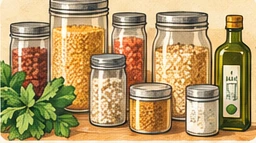
1. Begin with meals, not a perfect pantry
Picture two or three meals you actually like. Check what is in the fridge, freezer and cupboards. Write down what is missing. That is a shopping list with a purpose.
Look for useful overlap. Bread can become toast or sandwiches. A can of beans may work in a bowl, a soup or a side. Frozen vegetables can join rice, pasta or eggs. Choose the combinations that fit your household, storage space and tastes.
You can find more ideas on the public Fuel Board. A paper list or note on your phone works perfectly well; you do not need an account to learn this lesson.
One ingredient, several familiar meals
A can of beans might become a bowl with rice, a quick soup, or a filling for a tortilla. Plain yogurt might work for breakfast, a sauce, or a dip. A bag of carrots can be eaten raw, roasted, or stirred into soup. The point isn’t to stretch every ingredient into seven dinners; it’s to buy things that have a believable next use.
If you cook for one, smaller packages can make sense even when the price per ounce is higher. If you cook for several people, a larger package may be useful. Your freezer space and the food your household actually eats are part of the calculation.
2. Stock foods you already know how to use
A well-stocked kitchen is not a display of matching jars. It contains food you will make into meals. Use this as a menu of choices rather than a cart you have to fill all at once.
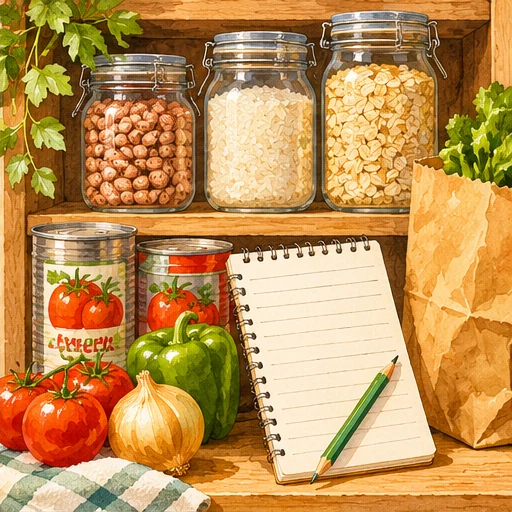
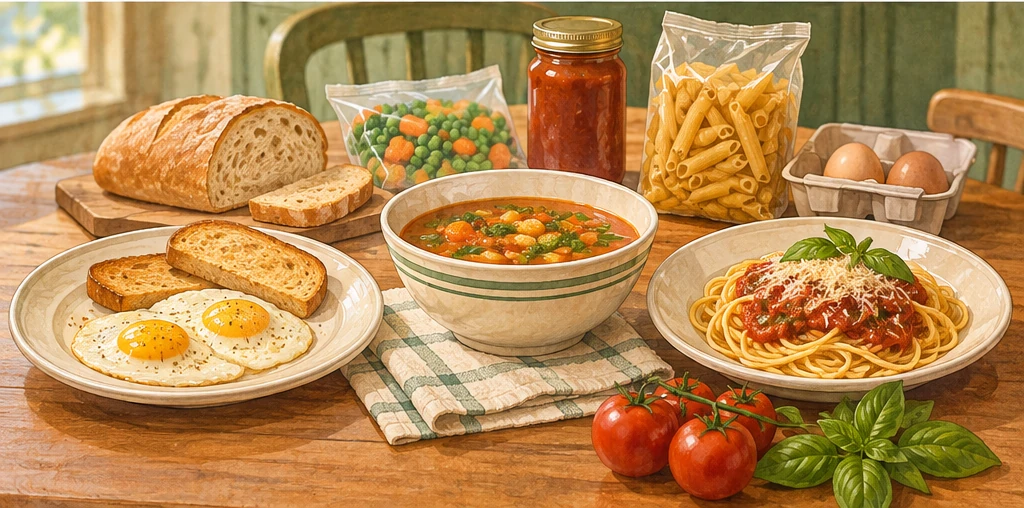
| Starting point | Examples | Ask yourself |
|---|---|---|
| A base | Rice, oats, pasta, bread or tortillas | Which of these do I already enjoy preparing? |
| Something substantial | Beans, eggs, canned fish or another protein you use | How much will I eat, and where will it be stored? |
| Produce | Fresh, frozen or canned fruit and vegetables | What should be used first? |
| Flavor | An oil, a favorite seasoning, sauce or vinegar | Does one of my meals actually need it? |
| Useful extras | Milk or an alternative, cheese, broth or recipe ingredients | What will happen to the remainder after opening? |
The pantry doesn’t have to look like a photograph
Group foods by how you reach for them: grains and pasta together, canned goods together, baking basics together. Put newer purchases behind older ones when appropriate, and check the packaging for storage instructions after opening. A clearly labeled shelf beats a perfectly styled jar collection when you’re trying to make dinner.
Some items need special care. Store dry goods in a cool, dry area, keep foods away from household chemicals, and follow package directions about refrigerating after opening. Don’t transfer a food into an unmarked container and then expect everyone else to guess what it is.
3. Look at the price and the amount
The number on the shelf tells you what you pay today. The unit price compares similar amounts, such as cents per ounce, when the store shows comparable units.
A made-up shopping example
The larger bag costs less per ounce but $1.60 more today. It only saves money if you can afford it, store it and use it.
Compare like with like, and keep your budget and available storage in the conversation. The least expensive unit price is not always the best choice for your home.
Two prices, two different questions
The shelf price tells you what you’ll pay today; the unit price helps compare the amount you’re getting. For example, a 16-ounce package at $3.68 costs 23 cents per ounce. A 24-ounce package at $4.80 costs 20 cents per ounce. The larger package is cheaper per ounce, but only useful if you’ll actually eat it before quality or safety becomes a problem.
Price tags can use different units, so compare the same unit. If a tag says “per pound” and another says “per ounce,” convert before deciding. Also look at the edible portion, shelf life, and how much preparation you can realistically do. The mathematics is useful; it doesn’t have to run your life.
4. Read the package before it goes in the cart
Check the cooking directions, ingredient list, amount and storage instructions. Some packaged foods need milk, eggs or other ingredients you might not have. A product that is shelf-stable until opened may need refrigeration afterward.
If someone in your household has a food allergy, read the full ingredient list and allergen information every time, even for familiar brands. The FDA explains that a separate “Contains” statement is not always present. Read the FDA guide.
Food dates also need context. Many U.S. labels describe quality, not a universal food-safety cutoff. Infant formula has specific use-by requirements. Do not ignore handling and storage instructions.
Small print that matters
Food-allergen declarations, storage directions, cooking directions, serving sizes, and whether something is a concentrate can change how you use a product. For someone with a food allergy, read the label every time: ingredients can change. If shopping for another household member, do not assume their needs are the same as yours.
For foods you store regularly, note which ones need refrigeration after opening and which should be used sooner. Safety rules, spoilage signs and recalls still matter even when the printed date has not arrived.
5. Give each purchase a place and a next use
Choose refrigerated and frozen products near the end of the trip, then put them away promptly. Keep raw meat and poultry contained so juices cannot reach ready-to-eat foods.
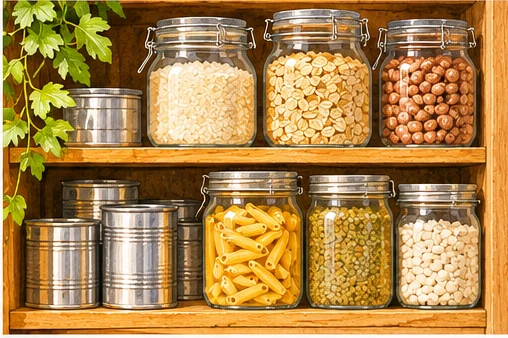
Put foods that should be used soon where you can see them, while keeping them at their appropriate temperatures. Leave a simple note if it helps: “Use the peppers with the rice” or “Freeze half the bread.”
The Storage & Cleanup lesson picks up from here.
A quick kitchen check before shopping again
Look in the refrigerator, freezer, pantry, and household cupboard. Are there half-used ingredients that need a plan? Is there something you’re always running out of? Keep a short note where you naturally look, whether that’s a phone, a paper list or your Feed Me Food Pantry. The best list is the one people will actually use.
6. Leave room for real life
Your pantry does not have to impress anyone. Frozen vegetables, canned beans, ready-prepared components and repeating meals can all be smart choices. The best routine is one you can actually use with the money, time and energy available.
If the week turns out differently than planned, start again with what you have. Food should make daily life easier, not create another list of things you are behind on.
Plans are allowed to change
If the week gets busy, frozen vegetables, canned fish or beans, eggs, and other familiar shortcuts can make a practical meal without much fuss. Just follow food-safety handling and cooking directions. A workable dinner is not a failed dinner because it doesn’t resemble the picture on the package.
Sources & further reading
Reliable references for the food-safety and equipment details in this lesson. Appliance directions can vary by model, so use the manual for your own equipment.
- FDA: Have Food Allergies? Read the Label
- FDA: Safe Food Handling
- University of Minnesota Extension: Unit Pricing
- N.C. Cooperative Extension: Home and food guidance
- FoodSafety.gov: Cold Food Storage Chart
- FDA: How to cut food waste and maintain food safety
Selected public references checked November 2026. Kitchen and appliance conditions vary; follow manufacturer instructions and relevant food-safety requirements.