

KITCHEN BASICS · LESSON 02
Pots, Pans & Everyday Tools
The shape of a pan and the feel of a familiar tool can teach you more than a display shelf ever will. Here is what everyday equipment actually does and how to care for it.
A kitchen-store display can make you feel as if you are missing half the equipment in the world. You probably are not. A reliable pan and a knife you like can take you surprisingly far.
1. Start with what your meals actually need
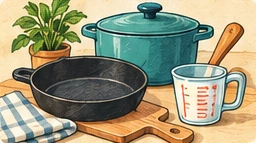
It is easy to stand in front of a wall of pans and wonder which one everyone else knows to buy. They do not all belong in your kitchen. Start with the meals you already make, then pick the pieces that will help.
| Piece | Starting size | What it is useful for |
|---|---|---|
| Skillet | About 10-12 inches | Eggs, vegetables, grilled sandwiches and other stovetop cooking. A lid is helpful for some recipes. |
| Saucepan with lid | About 2-3 quarts | Oatmeal, rice, sauces, smaller portions of soup and heating vegetables. |
| Rimmed baking sheet | A size that fits your oven | Roasting vegetables, baking and reheating foods that call for an oven-safe tray. |
| Larger pot with lid | About 4-6 quarts, when needed | Pasta, soup or larger portions that crowd a smaller saucepan. |
These are starting suggestions, not rules. Check the weight, cupboard space, burner size and how many people usually eat at your table. A one-person kitchen and a family kitchen may need different sizes.
Why a skillet and a pot behave differently
A skillet is wide and relatively shallow. That gives vegetables or a piece of fish room to release moisture, which helps the surface brown instead of steam. A saucepan is taller, with room for simmering liquid and stirring without sloshing it across the stove. A stockpot takes the same idea further for soups, pasta, or big batches. Different shapes, different jobs; none of them are a personality test.
A practical test: put a small amount of water in a cool, empty pan and notice how much of its bottom is covered. Now imagine that space full of vegetables. Crowding them into a tiny pan traps steam; using a larger one or cooking in batches may give you the result you wanted.
2. Choose cookware that fits your kitchen
Before thinking about brands or matching sets, look at the everyday details: can you lift the pan comfortably when it is full? Does it sit securely on your burner? Is the handle stable? Can you clean and store it without a struggle?
Induction, oven use and high heat need checking. Induction cooktops require compatible pans. Oven-safe temperatures can differ for a pan, its handle and its lid. A pan that looks all-metal is not automatically safe under a broiler.
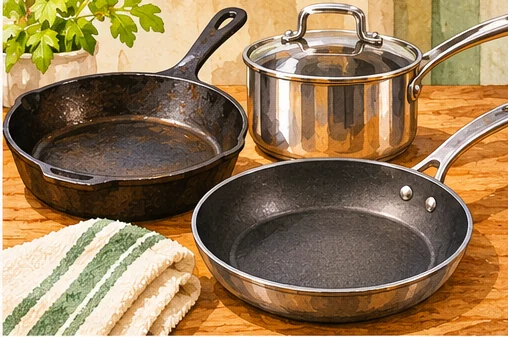
Stainless steel, cast iron and coated pans all have advantages and care needs. Choose what you are comfortable using. Follow the manufacturer’s directions for heating, utensils and cleaning, especially with coated cookware.
What the material changes
Stainless steel is durable and useful for browning and making pan sauces, but it can need a little more attention to heat and oil. Cast iron holds heat well and benefits from drying and maintenance after washing; modern cast iron can generally be cleaned with mild dish soap if its manufacturer allows it. Nonstick coatings can make delicate eggs easier, but they have limits on heat, utensils, wear, and lifespan. Look up the instructions for your particular pan before placing it under a broiler or preheating it empty.
On an induction cooktop, the base of the pan needs to work with magnetic induction. A fridge magnet that sticks firmly to the base is a helpful preliminary check, though the manufacturer’s compatibility guidance is the better final word.
3. Let the everyday jobs choose the tools
You need a way to cut food, stir or turn it, measure when the recipe calls for it, open packages and handle hot items. That does not require a matching collection.
| Tool | What it does | What can wait |
|---|---|---|
| A comfortable knife and stable cutting board | Prepares fruits, vegetables and other ingredients. | A large knife block or specialty slicers. |
| Measuring cups and spoons | Helps you follow unfamiliar recipes. | Gadgets that measure only one ingredient. |
| Spoon, turner and tongs | Stirs, flips and lifts food; choose materials suited to your pans. | Several duplicate sets. |
| Can opener and colander | Opens canned foods and drains pasta or rinsed ingredients. | Single-use gadgets. |
| Food thermometer and refrigerator thermometer | Checks cooking temperatures and cold-storage conditions. | Guessing temperatures from color or touch. |
| Dry oven mitts and food containers | Handle hot cookware and save leftovers. | A matching storage collection before you need it. |
A food thermometer and an appliance thermometer do different jobs. The official cooking-temperature chart is useful to keep handy.
One overlooked detail: the measuring cups
Dry measuring cups are filled and leveled across the top. A liquid measuring jug has a spout and room above the measurement line; set it on the counter and read at eye level. The ingredients may be the same, but the tool’s shape makes accurate measuring easier. This becomes especially handy when baking, where a little extra flour can make a noticeable difference.
4. Care for the tools you have
After cooking, let a pan cool according to its care instructions. Use the right cleaning tool for the surface and dry it before putting it away. If stacked pans scratch one another, separate them with a cloth or pan protector.
Do not leave sharp knives hidden in soapy sink water. Wash them where you can see the blade and store them securely. Clean boards and surfaces after handling raw meat, poultry or seafood, and before preparing ready-to-eat food.
The lesson on Storage & Cleanup covers a simple end-of-meal routine.
Small care habits that matter
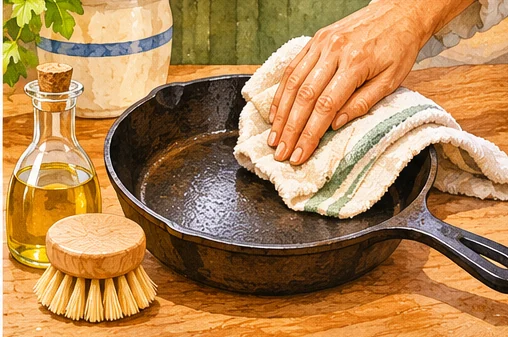
For cast iron, remove food residue, dry the pan thoroughly and apply a very light film of oil if the maker recommends it. For stainless steel, soak cooked-on food as directed and use a cleaning method approved for the finish. For coated cookware, avoid abrasive scrubbers and utensils that scratch it. Skip sudden hot-to-cold temperature shocks when the maker warns against them.
There is also a difference between an old pan with a little discoloration and a pan with a loose handle, deep crack, or damaged food-contact coating. The first may need cleaning; the second may need to be retired. Care and safety both count.
5. Know what can wait
An air fryer, stand mixer, food processor or special slicing tool can be wonderful when it solves a problem you have often. But you do not have to purchase one to prove you can cook.
Before buying a countertop air fryer, see whether your current oven has a convection or air-fry setting. Before buying the biggest stockpot, notice how often you truly cook a large batch. A kitchen develops through use, not through one shopping trip.
When a new tool really earns its place
Notice recurring problems. If cutting squash feels unsafe with your knife, for example, learn the safe technique and consider whether a suitable, well-maintained tool would help. If a saucepan regularly overflows when making soup, a larger pot may genuinely make life easier. Tools should answer a real need, not manufacture a new chore.
The quickest useful question is often, “What problem would this solve in my own kitchen?” If you have a clear answer, you can compare options with a much better eye.
Sources & further reading
Reliable references for the food-safety and equipment details in this lesson. Appliance directions can vary by model, so use the manual for your own equipment.
- FoodSafety.gov: Four Steps to Food Safety
- FoodSafety.gov: Safe Minimum Internal Temperatures
- U.S. Consumer Product Safety Commission: Recalls
- N.C. Cooperative Extension: Kitchen and home guides
Selected public references checked November 2026. Kitchen and appliance conditions vary; follow manufacturer instructions and relevant food-safety requirements.