

KITCHEN BASICS · LESSON 06
Storage & Cleanup
Taking care of food is part of making the meal. A short routine for cooling, storing and cleaning can make the next meal easier. Saving food never means keeping something you are unsure is safe.
1. Give food the right storage
Use an appliance thermometer: keep the refrigerator at 40°F / 4°C or below and the freezer at 0°F / −18°C or below. Keep cold air circulating rather than packing the refrigerator tightly. FDA storage guidance.
Keep raw meat, poultry and seafood in a leakproof container away from ready-to-eat food. Store dry goods in a clean, dry place and follow the instructions after opening. A package that was shelf-stable unopened may need refrigeration once opened.
Use the Cold Food Storage Chart for individual foods. Raw poultry and ground meats generally have much shorter refrigerator storage times than many cooked leftovers; one rule does not fit everything.
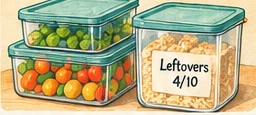
2. Put leftovers away promptly
Refrigerate perishable leftovers within two hours, or within one hour when the surrounding temperature is above 90°F / 32°C. Divide large amounts into shallow containers so they cool quickly. Hot food can go into the refrigerator; do not leave a large pot on the counter waiting for it to reach room temperature.
Use properly handled refrigerated leftovers within three to four days, or freeze them sooner for later use. Label the food and the date it was prepared. Freezing does not make food safe again after unsafe storage. USDA leftover guidance.
3. Freeze in portions you can use
Choose a freezer-suitable container or wrap, leave expansion space where appropriate, and label it. Freeze individual or household-size portions rather than one solid block that is inconvenient to use. Follow the container’s instructions.
Freezer storage recommendations often concern quality. Keep food continuously frozen at the recommended temperature, and use the official storage chart for the particular food. A date on a frozen container is not permission to ignore a power outage or thawing problem. Check the cold-storage chart.
4. Thaw and reheat safely
Thaw raw meat and poultry in the refrigerator, in cold water, or in the microwave. Do not thaw them on the kitchen counter.
For cold-water thawing: Seal the food in a leakproof bag and submerge it in cold tap water. Replace the water every 30 minutes. Once fully thawed, cook it immediately. Cook immediately after microwave thawing, too. Source: USDA – The Big Thaw: Safe Defrosting Methods.
Reheat leftovers to 165°F / 74°C throughout. In a microwave, cover and vent as directed, stir or rotate, allow standing time and check more than one place. When reheating in an oven, USDA advises an oven setting no lower than 325°F / 163°C. Do not use a slow cooker to reheat cold leftovers. USDA reheating guidance.
Reheat the portion you plan to eat. Keep track of the original preparation date; reheating is not a new storage clock.
5. Understand dates without guessing safety
“Best if used by” often concerns quality. Date labels are not a substitute for correct handling, and they are not identical for every food. Do not use infant formula after its use-by date. USDA food-date guidance.
You cannot reliably smell or taste the germs that make food unsafe. Do not taste food to decide whether it is safe. If time or temperature history is uncertain, discard it rather than trying to rescue it. FDA explains storage risks.
6. Close the kitchen with a small routine
- Put food away first. Deal with perishables before tackling the whole pile of dishes.
- Wash tools and surfaces. Use hot, soapy water for boards, utensils and work surfaces after use. Follow item-specific cleaning instructions.
- Prevent cross-contamination. Clean between raw-animal-food preparation and ready-to-eat tasks. Wash hands with soap and water for at least 20 seconds.
- Finish simply. Dry and put away tools, replace soiled towels, clear scraps and check that cooking controls are off.
If using a sanitizer or disinfectant, follow its label for food-contact surfaces, dilution, contact time and any required rinse. Never mix cleaning chemicals. Cleaning removes dirt; a surface-sanitizing product is not a substitute for washing first. CDC cleaning-product safety.
Store cleaning products away from food and out of children’s reach. See Pots, Pans & Everyday Tools for choosing equipment you can comfortably maintain.
Sources & further reading
Practical references for this lesson. Appliance instructions are model-specific; use your own manual.
- FDA: Are You Storing Food Safely?
- FoodSafety.gov: Cold Food Storage Chart
- USDA: Leftovers and Food Safety
- USDA: The Big Thaw – Safe Defrosting Methods
- USDA: Safe Ways to Reheat Food
- USDA: Food Product Dating
- FoodSafety.gov: Four Steps to Food Safety
- CDC: Cleaning and Disinfecting with Bleach
References reviewed October 2026. General kitchen education; not individualized medical or dietary advice.